Today, we know more about teaching than we ever have before. Research has shown us that teachers' actions in their classrooms have twice the impact on student achievement (Marzano, 2003a). We also know that one of the classroom teacher's most important jobs is managing the classroom effectively.
My number one goal when starting a new school year is establishing a positive, proactive environment through effective management practices. The secret to effective discipline is proactively building relationships, not reacting punitively to student misbehavior. I truly believe engaging students actively in the process of determining class rules and expectations can create a positive climate from the start.
Providing clarity about the content and expectations for instruction will guide students to understanding the rights and wrongs. To ensure I'm establishing and communicating learning goals, I manage my classroom with CHAMPs. Developed by Randy Sprick of Safe and Civil Schools, CHAMPs is widely used program that proactively promotes positive interactions.
In 2011, I wrote an article as a monthly guest columnist for Really Good Stuff about CHAMPs Management Program. In the spring of 2012, I received an email from Randy Sprick asking to feature the article in his spring newsletter of Safe and Civil Schools. Please link
here to read my featured post.
My CHAMPs aligned behavior charts are the largest component to my day. I break down each component of the workshop using the CHAMPs framework.
Establishing the lesson or work time with specific conversation levels, will guide the students to understanding if talking is allowed and what level it may be maintained.
There is nothing worse than explaining a task or working in small groups and having a little lovely interrupted repeatedly. Defining ways in which they may receive help eliminates lots of stress.
For this section, I kept the activity as a reminder of the content focus. I verbally ensure that kids are aware of the specific activity within the content focus.
Bathroom, water, and pencils can be another LARGE distraction. Expectations can be very different when learning in a whole group setting versus working independently. To ensure my
students understand the expectations, I clarify during transitions.
I've defined the levels of conversation, how to get help, the activity in which the kids are working, and what kind of movement may take place. Now I want to clarify what it means to participate by specifying work time as small groups, with a partner, alone.
Having CHAMPs to define classroom expectations sets students up for success. This file is available for the next 48 hours at half off the original price. Click the preview graphic for a link to this specific file.
The fun doesn't stop with a positive approach to behavior. I'm also featuring my Center Management Cards. Organization is key to successfully implementing effective centers.

A sharp, well-maintained classroom sends so many wonderful and powerful messages to students. Combing different aspects of the classroom from room arrangement to décor or supplies to curriculum support, you create an environment that reflects best teaching practices. Setting the stage for children to learn and ensure all is comfortable contributes to an effective working environment.
My center cards are designed to ensure that students are able to transition between two centers effectively. I designed my cards with warm and cool colors. Within this file, I have 40 different literacy center options and 10 math cards. I provided all options with a warm background and a cool background. Each week, I select 10 centers. To prevent myself from creating a lot of work, I keep many centers the same and rotate out one component. Example: Listening center receives a new book. Poetry center receives a new poem. Reading center has a new book bin. To add variety, I change out other centers. Example: One week we might work on the overhead. The following week I might use playdoh.
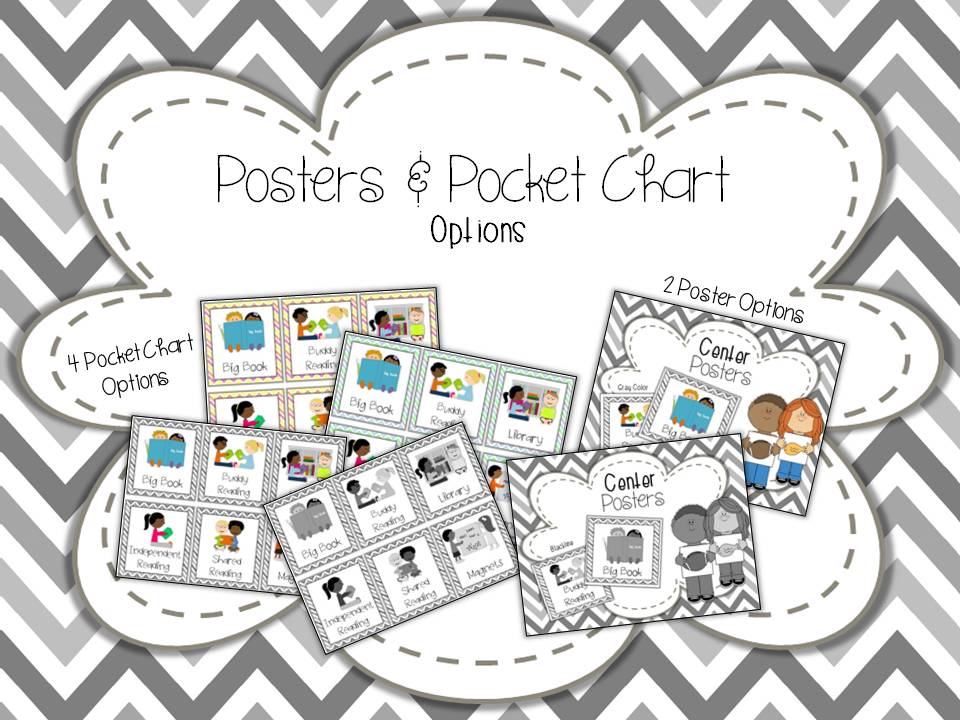
My students are aware of where to complete their center because I provided matching posters. Organization is key for the kids to understand when and where they must move to complete their centers.
Newly added to this file are teacher cards and posters. If you previously purchased, please redownload your update!
My favorite part of this file is providing my kiddos with the student cards so that they can personalize themselves for the pocket chart.